
Municipal debt – A tale of two cities, comparison of Johannesburg and Cape Town municipal debt experiences
Municipal debt
To maintain and grow infrastructure, local government needs to raise significant amounts of capital. In South Africa, metropolitan municipalities are usually unable to raise sufficient capital from their own reserves or Treasury grants. Consequently, they have to resort to obtaining loans from development agencies or commercial lenders. Relatively recent constraints on the local and national treasuries have resulted in the exponential growth in the debt of metropolitan municipalities. As debt increases, concerns about the repayments and the debt burden imposed on future ratepayers become a concern. This said, the experience of municipalities in South Africa varies widely, as is shown by comparing Cape Town and Johannesburg municipalities. While the increase in borrowing is most pronounced in Cape Town, the City of Johannesburg (CoJ) is facing a more difficult problem – the inability to raise loans to finance development. CoJ’s declining ability to raise money comes just as the collapse of infrastructure drives operating costs “through the roof”.
Recent trends in municipal borrowing.
Several traditional sources of municipal revenue have largely collapsed. As a rule, revenue from on-selling electricity and water services no longer makes a significant contribution to municipal coffers. As the efficiency of the suppliers of these bulk services (ESKOM and water boards) declined, they have merely passed the increased costs onto local councils. Local councils have, in turn, passed these costs onto residents who, in turn, have reduced their purchases. The decline in consumption further undermines municipal revenue. To aggravate the situation, declining revenue has been aggravated by losses arising from deteriorating utility infrastructure.
Municipalities, inevitably, resorted to borrowing money to fund their operations and capital projects. Increased debt is widely seen as easier than improving council performance or the efficiency of labour. Consequently, borrowing is now central to ensuring service delivery and maintaining infrastructure.
By contrasting the experiences of the Cape Town and Johannesburg municipalities in raising and leveraging debt shows it becomes apparent that debt per se is not problematic.
Cape Town vs. Johannesburg
In terms of revenue generated, the two metros are of similar size. In the two financial quarters ending December 2025 (the latest available data), Cape Town raked in revenue of R42 billion while Johannesburg acquired R51-billion (20% more). In this period, CoJ revenue was not sufficient to cover its expenditure. Expenditure by CoJ was slightly 2% greater than its revenue. By contrast, expenditure by the Cape Town municipality was 88% that of revenue, leaving it with excess income that could, inter alia, be used for capital projects. In the same period, capital expenditure in Cape Town was R13 billion versus the R8.7 billion invested by Johannesburg. Despite its stronger revenue base, Johannesburg’s investment in infrastructure was lower 28% lower than Cape Town’s.
Johannesburg is larger than Cape Town in terms of urban geography, population, and the size of the economy. Its infrastructure is patently in greater need of rehabilitation and development than that of Cape Town. Consequently, CoJ’s lower borrowing levels cannot be attributed to a reduced need for investment.
The higher capital investment in Cape Town was partly financed by increased borrowing. Since the end of 2022, Cape Town has raised new loans of R11.2 billion – almost double that raised by Johannesburg in the same period (R6.8 billion). CoJ’s lower borrowing levels seem to be the result of difficulty in raising loans. Lenders view CoJ as a higher risk and factor this into the price of the loans they make available. Since 2021, the CoJ loans (from lenders other than the World Bank’s IFC) have been at an interest rate of approximately 12.3%. This rate is higher than that charged to a resident borrowing from a commercial bank to purchase a new car.
By contrast, loans made to the City of Cape Town over the same period cost that city 9.6% per annum. In other words, loans acquired by CoJ cost the city about 30 percent more than those acquired by Cape Town.
The reasons for the premium paid by CoJ are clear. Half of the loans made to the Cape Town municipality were for the “provision of infrastructure”. The other loans were for the “provision of infrastructure” in combination with other objectives. By contrast, only 4% of the loans made to CoJ were purely for the ‘provision of infrastructure’. The vast majority of Johannesburg loans were thus for a combination of objectives, including operational and other costs. Loans for purposes other than capital investment are higher risk and routinely attract higher interest charges.
The higher charges imposed on CoJ are reflected in a decrease in new borrowing by that municipality. However, reduced borrowing should, ceteris paribus, result in the city’s debt levels declining or, at the very least, not increasing. However, debt levels in both CoJ and Cape Town continue to grow exponentially. Cape Town’s increasing debt levels are a result of the acquisition of new loans. By contrast, CoJ debt levels are increasing (exponentially) as a result of high finance charges and its failure to service existing loans. In the two quarters ending December 2025, the city failed to reduce the total amount owed on any of its current loans. Repayment on loans had not kept up with accruing interest, resulting in an increase in the total debt burden of the city. The quantum of what CoJ has to repay thus continues to increase even as new debt is not acquired. By contrast, CPT had managed to reduce (or at least halt increases) in the total amount it owes on each loan, limiting the growth of debt levels to new loans.
The graphic below reflects the cumulative value of loans currently held by the two cities. The recent rapid increase in debt held by CPT debt reflects the city’s appetite for loans after 2023.
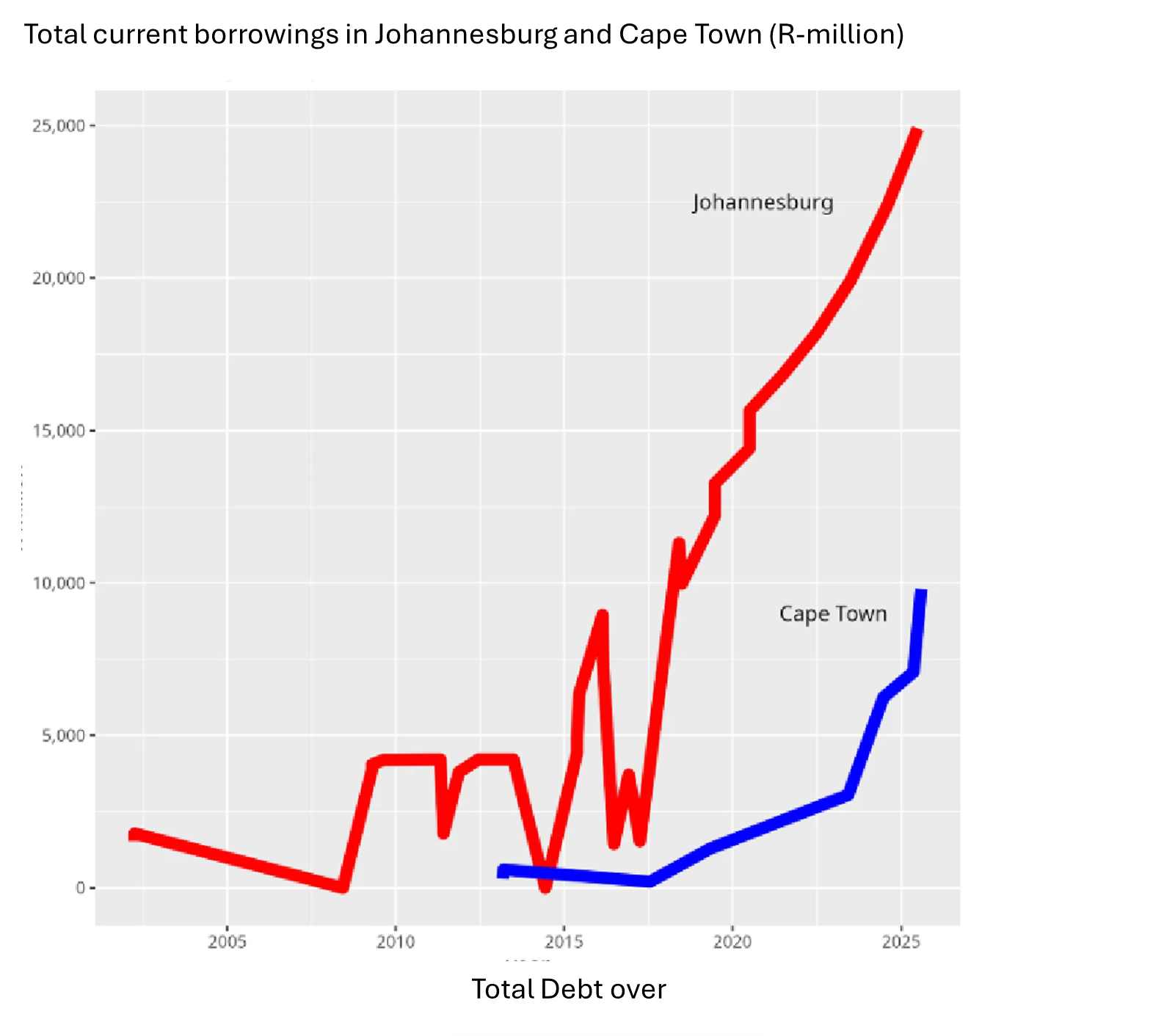
Currently, Johannesburg needs to service loans valued at R25 billion. This is equivalent to the total revenue accruing to the city in a single quarter. To service these loans, the city has to pay R3-billion per annum – approximately 3% of annual revenue.
The primary lender to South African Metropolitan municipalities has long been Agence Française de Développement (AFP). Recently, that “development agency” spurned CoJ’s request for additional loans. AFP allegedly cited the city’s failure to honour the terms of its 2024 loan.
The ‘debt’ crisis
As Cape Town’s debt has been rising as a result of new loans, the money raised is available for capital investment. By contrast, CoJ debt is rising as a result of its failure to service past debts. Moreover, much of the new debt raised by CoJ is destined for items other than capital investment. The situation CoJ finds itself in is set to be further aggravated by the Johannesburg Stock Exchange suspending the city’s debt securities. Following this suspension for ostensibly “technical reporting” reasons, the Global Credit Rating Company downgraded the city’s credit outlook rating. Moody’s then placed the city on review for a potential downgrade. These factors are certain to raise the cost of any loans made available to CoJ and could drive the cost of existing loans up.
CoJ thus faces a debt crisis; however, the crisis is less one of being unable to service current debts than a crisis of not being able to obtain reasonably priced loans. Without sufficient capital investment, CoJ will be unable to reduce the proportion of water lost to leakages, prevent the degradation of electricity reticulation infrastructure, or maintain public roads. Essentially, the collapse of the infrastructure will continue to drive the cost of providing public goods and trading services ever higher. As the urban infrastructure lays the foundation for employment and business development, the CoJ’s ability to attract investment, create jobs, and provide economic opportunities will deteriorate.
The salvation of Johannesburg rests on its obtaining “cheap” loans from the World Bank or the IMF. While such loans are provided at interest rates that are a fraction of those charged by, for example, AFP, they come with conditions that will require the city to reform the way it operates. These inevitably painful reforms will probably be exactly what is required for the city to halt the current death spiral.
Michael O’Donovan is a specialist in the analysis and management of large socio-economic and political databases. He holds a master’s degree in sociology and focuses on improving quantitative analysis in the social sciences. His work combines statistical analysis, GIS, and open-source tools such as R, GRASS, PostgreSQL, and Mapserver to analyse issues including crime, political behaviour, development, migration, and hidden populations. He has worked with clients such as the Open Society Foundation, the Institute for Security Studies, the Office of the State President, the HSRC, and the University of the Witwatersrand.