

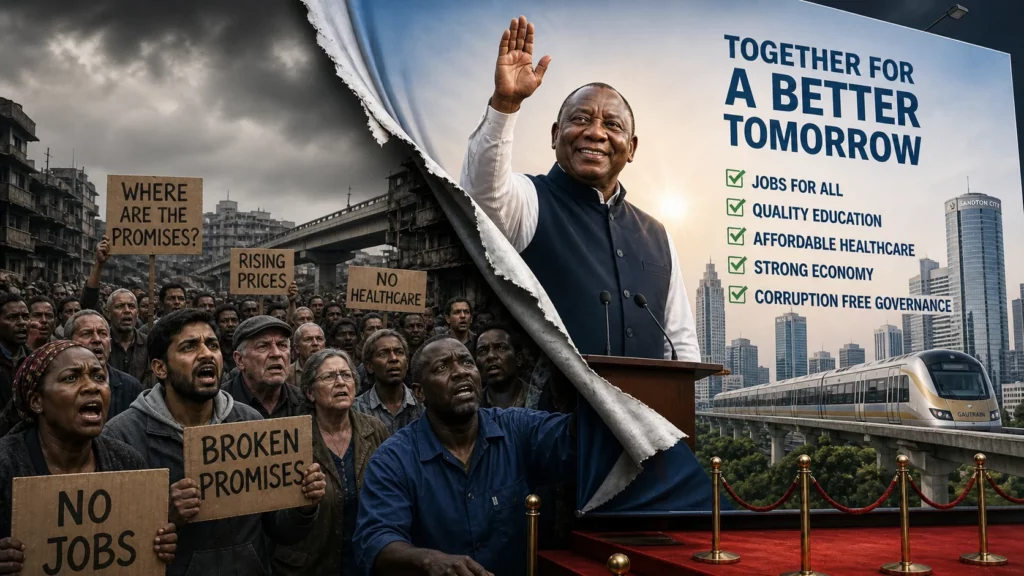
On Wednesday, 4 November 2026, President Cyril Ramaphosa set the date for South Africa’s next local government elections. The timing matters because municipal politics is where trust in the state becomes brutally tangible: a working tap, a passable road, a functioning sewer line, a streetlight that stays on, a refuse truck that actually arrives. It also matters because the ruling African National Congress (ANC) already crossed two symbolic thresholds: in the 2021 local elections it fell to 45.59% of the vote, and in the 2024 national election it dropped to 40.18%. November 2026 will therefore test not only party loyalty, but whether municipal decline is a strong enough motive for it to become a vote for change.
From Access to Reliability – Why Lived Service Delivery May Decide the Vote
The central question of this election is not ideological – it is practical. In an address to the Extended President’s Coordinating Council on 30 April 2026, President Ramaphosa acknowledged that many municipalities lack the revenue base, skills and institutional capability to deliver services. He said this resulted in poor service delivery in which water and electricity disruptions are common and roads and other infrastructure are not maintained. He made the same case two weeks earlier at the National Local Economic Development Summit, warning that weak financial management, failed maintenance, wasteful expenditure and poor consequence management are translating into unreliable electricity, water insecurity, poor roads and unsafe trading environments.
To be fair, the story is not that nothing improved after 1994. Statistics South Africa says access to basic services improved between 2011 and 2022, with gains in water, sanitation, electricity and refuse removal. But access is not the same thing as reliability. In his 30 April 2026 address, the Presidenct noted that households experiencing water interruptions lasting more than two days increased from 24% in 2012 to 34% in 2024, while many municipalities are budgeting less than 1% for maintenance against a National Treasury guideline of 8%. That is the real political danger for the ruling party – citizens may hear official claims of historical progress, but they are voting on today’s lived experience.
Municipal Collapse in Numbers – The Service-Delivery Crisis Voters Can No Longer Ignore
The hard numbers are devastating. In March 2026, Deputy President Paul Mashatile said 162 municipalities were identified as financially distressed in the 2023/24 financial year, 113 municipal budgets were unfunded, and the combined revenue shortfall was R35.9 billion. Government also acknowledged that Section 139 interventions have often failed to produce sustainable results. By September 2025, the Department of Cooperative Governance said that 39 municipalities were under Section 139 interventions and four were under Section 139(7) national interventions. This is not the profile of a local government system under pressure – it is the profile of one that is structurally unstable.
According to Soth Africa’s Auditor-General (AGSA) , the 2023/24 local government audit cycle still showed deep institutional weakness – 28 municipalities had disclaimed audit opinions, 13 audits were outstanding, and seven municipalities were repeatedly late in submitting financial statements and performance reports. The same audit found indicators of financial strain in 78% of municipalities assessed, an average of 286 days to pay creditors, 113 unfunded budgets, and losses associated with water and electricity distribution running to R14.93 billion and R22.36 billion respectively. Too many municipalities are not merely struggling to improve outcomes, they are struggling to perform the elementary administration functions.
The corruption picture is just as corrosive. AGSA reported 446 material irregularities tied to non-compliance and suspected fraud, with estimated material financial losses of R8.74 billion. Those irregularities included payments for goods and services not received or not in line with contract terms, unfair or uneconomical procurement, revenue not billed or recovered, and even harm to the public through pollution of water resources. Meanwhile, the Special Investigating Unit’s local-government proclamation pages show a steady pipeline of investigations into municipalities in 2024 and 2025, including an investigation into water and sanitation services in eThekwini. Parliament’s April 2026 follow-up oversight in the Free State described deep-seated governance failures, billions owed to creditors, irregular tenders, more than R7 billion in unauthorised, irregular, fruitless and wasteful expenditure in some municipalities, and areas where service delivery had “collapsed entirely.”
The collapse of municipal water and sanitation systems is especially politically explosive because it turns administrative failure into daily humiliation. The Department of Water and Sanitation said in April 2026 that the 2025 Green Drop Report found 47% of audited wastewater systems in a critical condition, up from 39% in 2022, while only 14 systems achieved Green Drop certification. The same release said non-revenue water remains “stabilised but unacceptably high” at 47.3%. President Ramaphosa added that the eight metros are losing an average of 34% of purchased water before it can be billed and that municipal debt to water boards tripled between 2018 and 2025. Voters do not need to read the Green Drop report to know what this means. They smell it, queue for it and pay for it.
The democratic warning light is flashing
This is why the latest democracy warning matters so much. Recent HSRC voter-participation findings commissioned by the Electoral Commission of South Africa show that demand for democracy has fallen from roughly the mid-2000s level of 65% to 67% down to a historic 36% in 2026. Separate recent reporting on the same HSRC findings said only 17% of South Africans are satisfied with how the democratic system is working and that about one in four citizens is now open to “strong man” non-democratic alternatives. The survey was conducted through face-to-face interviews with citizens aged 16 and older across all provinces. That is no longer ordinary dissatisfaction. It is democratic fatigue becoming measurable.
That conclusion is reinforced by other current research. An April 2026 Afrobarometer brief on South Africa said citizens’ attitudes toward democracy still hinge on government performance. In other words, failing services, corruption and non-responsive institutions do not only reduce satisfaction with incumbents; they weaken attachment to democratic practice itself. When the state repeatedly fails at the local level, democracy begins to feel abstract, procedural and hollow.
That is why turnout will matter as much as party preference. The IEC’s official reports show voter turnout in the 2021 local elections was just 45.86%, while national turnout in 2024 was 58.64%. HSRC reporting after the 2024 election noted that more than 11 million registered voters did not cast ballots. The danger for November is therefore double-edged – the ANC can lose support because of municipal failure, but opposition parties can still fail to benefit if disillusioned voters choose silence instead of a new party.
From Frustration to the Ballot Box: The Fight to Make Change Believable
The evidence suggests, but does not guarantee, that there is a real electoral opening against the ANC. Yet that same evidence also suggests that frustration does not automatically convert into an opposition breakthrough. It often converts into abstention, fatalism and a belief that politics does not respond. GeoScope’s own election-related work, drawing on HSRC-linked survey environments, argues that many younger voters feel politicians do not understand their specific needs, do not send appropriate messages and do not improve their socio-economic conditions. That means the battlefield is not just between parties. It is between change and withdrawal.
So the question remains, “Will voters vote for change, or will they stay with the ruling party?” The answer is sharper than it first appears. Some voters will punish the ANC. Some will stay with it out of history, identity, patronage ties, fear of unstable coalitions, or lack of faith in the alternatives. And many may simply stay home if they believe every manifesto is generic and every promise is recycled. In that sense, the opposition’s task is not merely to challenge the ANC, it is to make change feel concrete, local and believable. The party that can do that ward by ward, street by street and issue by issue is the party most likely to convert anger into ballots.
GeoScope Turning Voter Frustration into a Local Intelligence Advantage
This is where GeoScope becomes strategically important. GeoScope’ offers value-added local datasets built from the General Household Survey, the South African Social Attitudes Survey and the Marketing All Products Survey, alongside demographic estimates, living-standard measures, income data, shopping-mall trade areas, crime profiles, retail-outlet databases, township atlases and gross geographic product data. Our KasiGHS, Kasi SASAS, KasiMAPS and Circle Point Analysis are designed to let users analyse service-delivery conditions, social attitudes, political values, consumer behaviour and socio-economic conditions at a much more local and spatially aware level than conventional national summaries.
The methodology matters as much as the datasets. GeoScope’s KasiSurveys approach geocodes nationally representative household survey data and classifies records by township boundaries, allowing comparisons within and outside townships and used with our unique Circle Point Analysis reveals spatial patterns. GeoScope also supports the HSRC’s in conducting their SASAS and IEC exit poll, including fieldwork, technology support and quality control to verify that field teams reached the sampled areas and completed sufficient interviews.
Using GeoScope’s survey and geospatial tools, a party could move beyond provincial slogans and diagnose the actual emotional and service-delivery map of a municipality. Surveys can infer whether a ward’s dominant pain is water reliability, sewer overflows, electricity interruptions, billing injustice, bad roads, crime exposure, youth alienation, or corruption fatigue. Surveys cab distinguish township concerns from suburban concerns, identify where anger is translating into protest risk or abstention risk, and test whether residents want the language of clean government, technical competence, local jobs, visible maintenance, or stricter consequence management. That is how a manifesto stops being a national brochure and becomes a credible municipal contract.
More importantly, GeoScope can help parties adapt not just what they say, but where and to whom they say it. If a municipality’s local data shows persistent water interruptions, distrust in politicians and high perceived corruption, the winning message should not be abstract “development.” It should be a specific offer: ring-fence water revenue, appoint qualified engineers, publish maintenance schedules, fix leaks first, and name the consequences for tender abuse. If another municipality’s data shows that younger residents feel unseen and unconvinced, parties need targeted youth-facing messages, credible local candidates and campaign activity in the places and channels where younger voters actually live their lives. GeoScope’s value is that it can help parties listen before they speak. And in a democracy suffering from exhaustion, listening is no longer a soft skill – it is a competitive advantage.
In the end, this election will not be decided by nostalgia or outrage alone. It will be decided by whether voters believe someone can govern their municipality better than the people governing it now. The ANC will ask for another chance. Opposition parties will ask for a mandate. But the real ballot question will be simpler and harsher – who can keep the water flowing, the lights on, the roads usable, the books honest and the officials accountable? If enough voters answer that question with courage, November 2026 could become a local-government turning point. If voters answer with resignation, the real winner will not be any political party, but disillusionment itself. It will be political apathy.
Bob Currin is an economist with a long and distinguished record of studying MSMEs and business activity across South Africa, the African continent, and parts of Asia. As the founder and director of AfricaScope and GeoScope, he has spent decades developing advanced survey methodologies, enterprise mapping systems, and geospatial analytics that provide deep insight into the realities of small businesses, informal enterprises, and local economic ecosystems. His work has informed policymakers, international development partners, and private-sector leaders, and continues to shape evidence-based approaches to understanding and strengthening entrepreneurship in emerging markets.
