


A review of South Africa’s grocery market between 2023 and 2025 showed that it remains diversified and has become more sharply segmented. This was evident from an analysis of consumers’ purchasing behaviour of grocery brands using the Marketing All Product Survey (MAPS) data. The analysis focused on grocery consumers’ household purchasing power, shopping missions, consumer confidence, and retailers’ ability to deliver a clear value or premium proposition. The analysis shows that the grocery market has largely remained consistent across these years:
- Woolworths remains the premium customer brand;
- Checkers and Pick n Pay occupy the middle-to-upper market;
- Boxer and Shoprite position closer to value-oriented households;
- SPAR acts as a more locally anchored, less sharply differentiated bridging brand.
Key takeaways
- Woolworths clearly remains the premium grocery brand, anchored by LSM 10 and high-consumption-capacity and consumption-potential households.
- Checkers and Pick n Pay remain on the more affluent side of the market, but Checkers appears more strongly associated with upper-middle income households and retail modernisation.
- Boxer and Shoprite retain stronger value-market associations, although Boxer appears more exposed to financially pressured households.
- Reported use for any grocery brand fell between the two years, which reflects the economic pressure being faced by all consumers
- The most important strategic shift is the widening importance of value, convenience, digital delivery and household affordability.
Living Standards Shape Grocery Choice From Value to Premium Markets
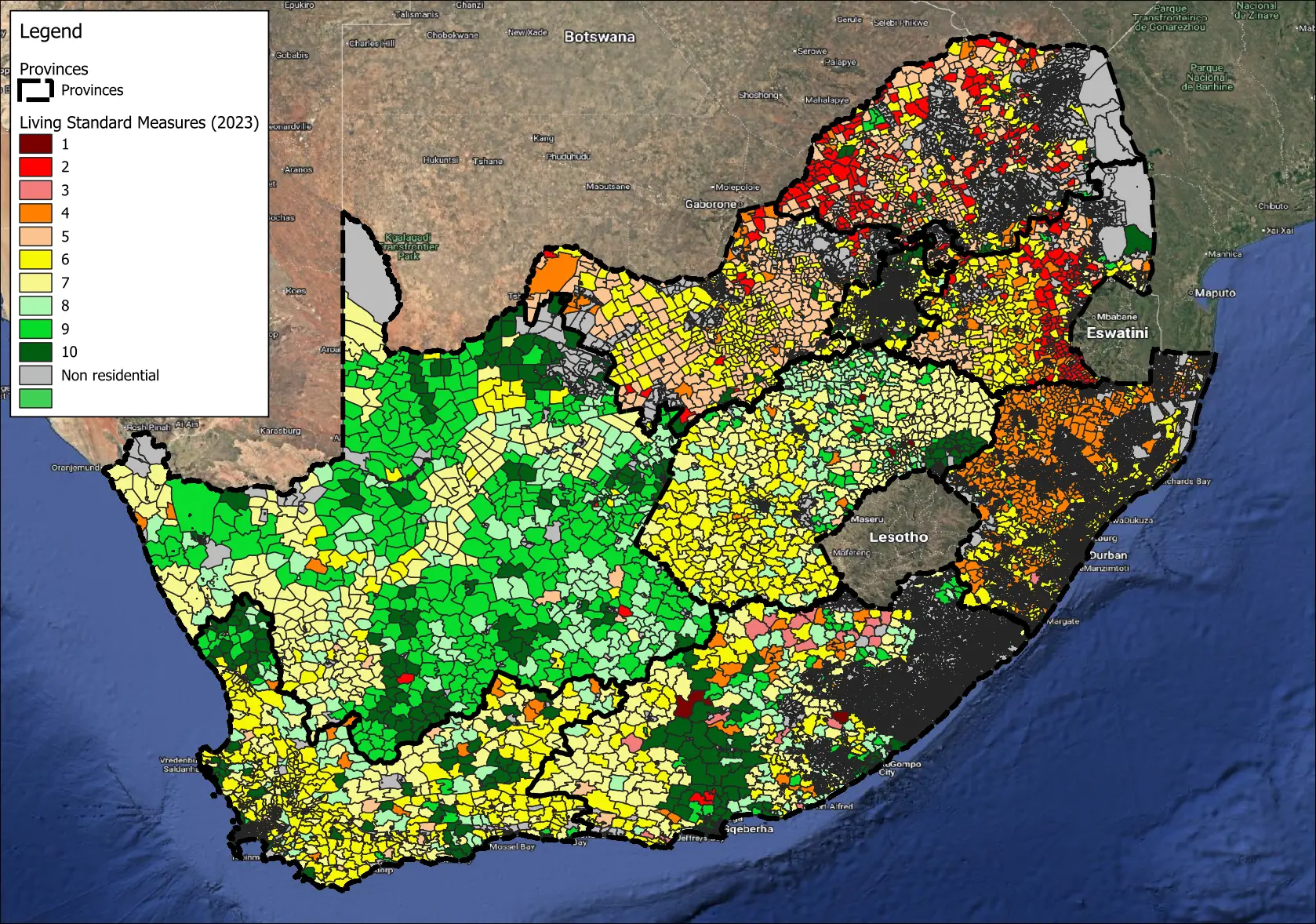
Living Standard Measures (LSMs) remain a strong determinant of grocery-brand positioning, accounting for more than 84% of the variation in brand positioning across the market. The LSM pattern remains exceptionally clear:
- LSM 1 to LSM 5 households, located mainly in rural areas and small towns, sit towards the value-oriented side of the market
- LSM 6 and LSM 7, located predominantly in townships and farming communities that occupy the middle market
- LSM 8 to LSM 10 make up the premium side of the market, located predominantly within upper-income urban areas.
The LSM map below shows how the segmentation varies significantly across provinces, with each province exhibiting distinctive patterns. A distinguishing factor is how rural farming communities in provinces such as the Western Cape, Eastern Cape, and Free State differ from more traditional communities in provinces such as KwaZulu-Natal, Mpumalanga, Limpopo, and the Northwest Province.
In practical terms, the BMR segmentation and LSM results distinguish lower-consumption-capacity households from higher-consumption-capacity households, with the former positioned closer to the value end of the market and the latter towards the premium end. This segmentation fits the broader consumer environment, where food and non-alcoholic beverage inflation reached 8.5% year-on-year in December 2023, placing severe pressure on household budgets. Food inflation eased later but remained material during 2025 and rose sharply again in the middle of the year.
Woolworths’ Premium Positioning Remains Its Competitive Advantage
Woolworths remains the most distinctive retailer in both years. It sits in the high-LSM end of the market and remains closest to LSM 10 with its high-consumption-capacity and high-consumption-potential households.
Woolworths does not merely attract affluent households; it occupies a distinct premium space within the grocery market, rather than competing head-on with other brands.
That distinction gives Woolworths a strategic advantage by protecting its quality, premium food credentials, convenience, sustainability, and a differentiated shopper experience. Its strongest equity lies in premium relevance rather than lowest-price credibility.
Checkers and Pick n Pay – Similar Territories, Different Signals
Checkers and Pick n Pay both are more strongly associated with LSM 8 and LSM 9 households than with other consumers. Checkers sits further towards the upper-middle consumer space, while Pick n Pay remains slightly closer to the middle of the premium-value continuum.
In 2025, Checkers is more strongly associated with a higher-consumption-capacity market that is more concerned about corruption, energy prices, and the state of the economy. Pick n Pay occupies a similar position but sits closer to LSM 8 and to consumers who remain sensitive to broader economic and household-budget pressures.
The market context supports this interpretation. Shoprite reported 13.8% sales growth for Checkers and Checkers Hyper in its 2025 financial year, while Sixty60 sales increased by 47.7% to R18.9 billion, underscoring how premium food, digital convenience, and on-demand delivery have strengthened Checkers’ position.
Pick n Pay, on the other hand, faces a more complex challenge. Its core supermarket business has been rebuilding after years of pressure, with the group’s 2025 financial results showing modest Pick n Pay turnover growth as part of its multi-year turnaround strategy, alongside stronger Boxer growth.
Boxer and Shoprite – Value Still Matters, but the Value Market Is Not One Market
Boxer remains strongly associated with the value side of the grocery market. In 2025, it sits closer to lower consumption capacity and potential, and to LSM 5 households predominantly in rural towns across the country. Their consumers are concerned about finding work or affording food and groceries.
This does not mean Boxer shoppers only buy on price. It means the Boxer customer base is more exposed to financial pressure, making price architecture, pack-size relevance, promotions, cash-based payment convenience and accessible store locations essential parts of the brand proposition.
Shoprite occupies a slightly different value position. It sits closer to LSM 6, the metropolitan township market, and in the lower- to middle-income market. This suggests a broader mass-market role that can serve financially constrained consumers without being positioned as the narrowly discount-focused Boxer.
The broader sector reinforces the importance of this value space. Shoprite and Usave reported 5.9% sales growth in the 2025 period, while Boxer’s total growth in its financial results to 2 March 2025 was 13.2%, continuing to support Pick n Pay Group during its turnaround.
SPAR Convenience, Locality and Less Defined Positioning
SPAR remains close to the centre of the grocery market, indicating that it has a more mixed consumer profile, spanning local convenience, neighbourhood shopping, top-up trips, and family grocery missions rather than a single, sharply defined consumption segment.
The 2025 analysis places SPAR closer to consumers’ central concerns and attitudes than strongly premium or value brands. Its position implies that local store execution, independent-retailer quality, community relevance, fresh-food credibility, and convenience remain more important than a single national socio-economic identity. This places SPAR closest to fuel station express stores, which serve as a more specific convenience-shopping mission.
Factors Shaping the Grocery Market – Living Standards & Consumer Trends
The Bureau of Market Research (BMR) segmentation and LSM variables provide the strongest explanation of grocery retailer positions in the market. The analysis shows that income does not differentiate grocery-brand use as strongly as living standards, consumption capacity, and value orientation do. Consumer concerns add more nuance to the grocery market in 2025. Boxer sits closer to consumers concerned about unemployment and food costs, while consumers at Pick n Pay and Checkers are more concerned about corruption, energy prices, and the wider economy.
Credit and loan attitudes play a smaller role. Most loan-attitude categories sit closer to the centre of the map, although Pick n Pay shows an association with stronger disagreement that borrowing should fund leisure activities, while Boxer and Shoprite sit somewhat closer to more price-sensitive or cautious lending attitudes.
Although the analysis shows that South Africa’s grocery market retained a clear value-to-premium structure, most retailer customer profiles shifted towards a more value-conscious and financially constrained consumer environment. Boxer and Shoprite became more strongly associated with lower-capacity, affordability-focused households, while SPAR remained closer to the middle, reflecting a broad and mixed neighbourhood-convenience customer base. Pick n Pay and Checkers moved nearer the centre of the market, suggesting a broader and somewhat more price-sensitive customer profile, although Checkers retained its upper-middle positioning. Woolworths remained the most distinctive premium retailer, continuing to align with high-LSM and high-consumption-capacity households despite a modest movement towards the centre.
From Positioning to Performance – What Grocery Brands May Potentially Do Next
Pick n Pay should strengthen its role as a credible value-and-quality family supermarket focusing on LSM 7 to LSM 9 consumers rather than the lower-end LSM 6 township market. It needs sharper price communication, better fresh-food execution, stronger store consistency and clear reasons for customers to use the brand across both main grocery and top-up missions.
Checkers should continue building its premium-convenience advantage. Its future lies in combining strong store presentation, differentiated food ranges, digital ordering through Sixty60, Xtra Savings and an experience that feels more aspirational than a standard weekly grocery trip.
SPAR should strengthen its position as South Africa’s most trusted neighbourhood convenience retailer rather than competing directly with value- or premium-led brands. Its mixed customer base creates an opportunity to win through consistently well-run local stores, reliable fresh-food quality, relevant promotions, convenient top-up shopping, and ranges tailored to each community’s needs. The priority should be to improve the consistency of independent-store execution, reinforce value for households under pressure, and make convenience, locality, and customer service a clearer part of the SPAR proposition.
Boxer and Shoprite should protect affordability while improving the practical shopping experience. Their opportunity lies in price trust, accessible locations, strong availability, relevant pack sizes and a store network that supports households whose budgets remain exposed to food, transport and employment pressures.
GeoScope can help retailers turn broad consumer-positioning insights into local, store-level action. Through GeoMAPS Consumer, retailers can link household profiles, purchasing behaviour and value perceptions to store trade areas, enabling them to identify and sustain their core customer markets while also pinpointing underserved locations and consumer segments that offer opportunities for growth. Combined with retail outlet mapping and ongoing consumer trend analysis, this provides a practical basis for refining store formats, promotions, ranges, delivery coverage, and network expansion in line with the needs of each local market.
Frequently Asked Questions
Do changes from 2023 to 2025 mean a retailer gained or lost market share?
No. The analysis measures relative associations between retailer use and customer-profile variables, not sales, market share, revenue or loyalty. A retailer can move because the consumer mix has changed, or because another retailer’s position has become more or less distinctive. The reported grocery purchasing behaviour is useful indicators of shopper reach, but should be supplemented with audited sales, loyalty card data, transaction data, or retailer financial results.
Why did every retailer show lower values for use in 2025?
The reported decline across all brands suggests that this is not a simple retailer-by-retailer commercial story. The correct interpretation is that the 2025 analysis still shows the relative hierarchy of brands within the market, but the change in use-rate comparison should be triangulated with sales data, store counts, loyalty data and market-share research before making investment decisions.
How should a retailer use the analysis results in practice?
Retailers should use MAPS data as a strategic segmentation tool. It can identify which household types, value perceptions, concerns and behavioural attitudes most closely associate with the brand, then connect those profiles to locations, stores, competitors and catchments. The next step is to map the profiles geographically, identify where a retailer under-trades or over-trades relative to local potential, and tailor store formats, promotions, assortment, media, and delivery coverage to the actual customer profile in each market.
Craig Schwabe is Director and Geospatial Services Manager at GeoScope and AfricaScope, where he leads geospatial and GIS work focused on translating market, consumer and location data into practical business decisions. His private-sector work includes retail network optimisation, trade-area analysis, accessibility modelling, store-location planning, competitor mapping and the profiling of consumer markets across South Africa and Africa. Craig’s work focuses on helping brands determine where to protect and optimise existing stores, where market saturation or cannibalisation may constrain growth, and where white-space opportunities exist for new outlets. His approach combines consumer, demographic, spending-power, accessibility and outlet-location data to identify underserved markets, estimate store potential, benchmark performance against local demand, and support evidence-based decisions on expansion, rationalisation, formats and geographic coverage. His published work reflects a sustained focus on retail network development, trade-area definition, gap analysis and the use of geospatial intelligence to improve return on investment in the retail sector.
