

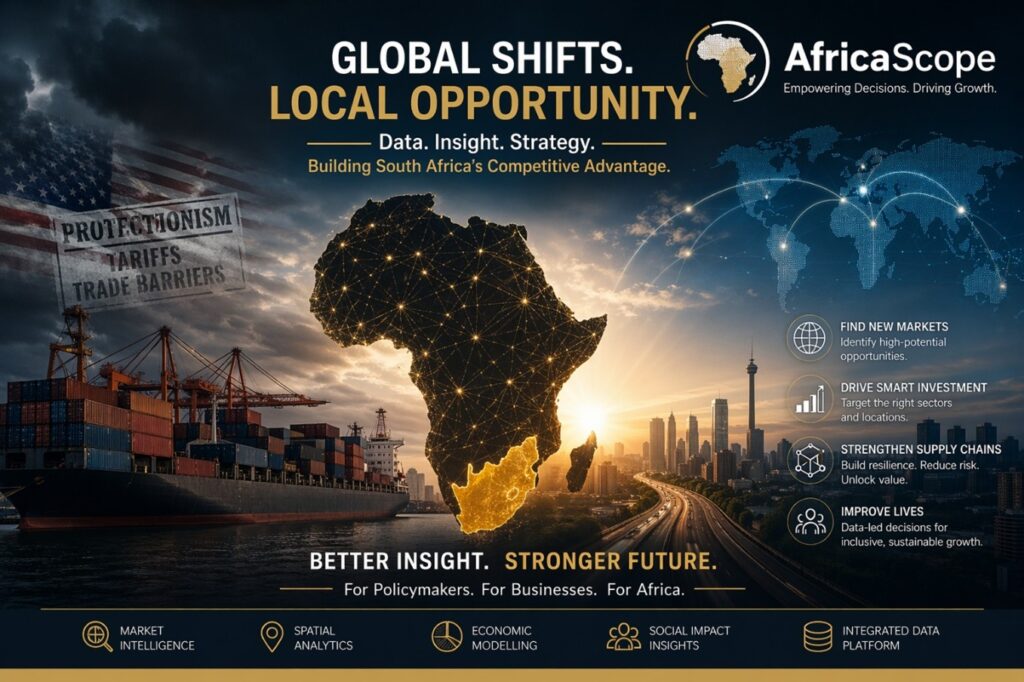
The global economy is once again entering a period of profound transition. Trade relationships that once appeared stable are being reshaped by rising protectionism, geopolitical tension, and a renewed focus on domestic economic priorities in major economies. For South Africa, this shift is not theoretical, it is already being felt across key sectors, from automotive manufacturing to agriculture.
The GPL Policy Brief (March 2026): “Evaluating how a return to ‘America First’ policies might affect international trade, including impact on global supply chains, multinational corporations and emerging markets” offers a timely and sobering assessment of this new reality. It paints a picture of a world where globalisation is no longer the dominant force it once was, and where emerging markets must rapidly adapt or risk being left behind.
At the heart of the paper is a simple but powerful observation: protectionist policies, particularly the imposition of tariffs, are reshaping the rules of trade. The United States’ decision to impose a 30% tariff on South African exports represents more than just a policy adjustment – it signals a structural shift in global trade dynamics. While such measures may provide short-term benefits to domestic industries in the US, the broader consequences for countries like South Africa are far-reaching.
Tariffs, Trade Shifts, and the New Geography of Opportunity
South Africa’s export sectors – particularly automotive, agriculture, and mining – are deeply integrated into global markets. When tariffs increase, competitiveness declines. Demand softens. Production slows. And ultimately, jobs are placed at risk, often in regions where alternative opportunities are limited. The paper highlights how these pressures are already emerging, with declining export volumes and growing uncertainty undermining business confidence and economic growth prospects.
Yet the paper does not present this shift purely as a threat. It also points to an important and often overlooked reality – disruption creates opportunity. As traditional trade routes become less viable, new pathways begin to emerge. The weakening of preferential access to US markets compels South Africa to accelerate its engagement with alternative partners, particularly within the BRICS bloc, the European Union, and across the African continent.
This is not simply a matter of redirecting exports. It is a far more complex strategic challenge. It requires understanding where demand exists, how markets are evolving, and which sectors are best positioned to compete in a changing environment. It requires identifying where infrastructure investment will yield the greatest return, and how industrial policy can be aligned with global trends. Above all, it requires a level of insight and precision that goes beyond traditional economic analysis.
Turning Trade Uncertainty into Strategic Insight
This is where AfricaScope becomes critically important.
In an environment defined by uncertainty, data is no longer a supporting tool – it is the foundation of strategy. AfricaScope’s ability to integrate market research, spatial analytics, and economic modelling provides policymakers and businesses with a clear line of sight into an otherwise complex and shifting landscape.
Consider the challenge of market diversification. The paper calls for South Africa to expand trade relationships beyond the United States, but the question is not simply where to go – it is where to go effectively. AfricaScope enables this by identifying high-potential markets based on demand patterns, sector performance, and trade accessibility. It transforms diversification from a policy aspiration into a targeted, actionable strategy.
At the same time, the role of geography in economic development becomes increasingly important. Initiatives such as Special Economic Zones, highlighted in the paper through the example of the Tshwane Automotive Special Economic Zone, which demonstrate the potential to drive industrial growth and attract investment. But their success depends on precise location planning, infrastructure alignment, and a deep understanding of surrounding economic ecosystems. Through its GIS capabilities, AfricaScope provides exactly this level of spatial intelligence, ensuring that investment decisions are grounded in reality rather than assumption.
Building Resilience in a More Fragmented Global Economy
The implications extend further. As global supply chains are reconfigured, businesses must reassess how and where they operate. AfricaScope’s data allows firms to map supply chain vulnerabilities, identify opportunities for localisation, and optimise logistics in a way that enhances resilience. For government, the same data can be used to design targeted interventions, supporting industries and regions most exposed to external shocks, while fostering growth in emerging sectors.
Perhaps most importantly, the paper reminds us that economic policy cannot be separated from its social consequences. The impact of tariffs is not confined to balance sheets; it is felt in communities, particularly in rural areas and industrial towns where employment is concentrated in vulnerable sectors. AfricaScope’s integrated datasets, linking economic activity with demographic and household-level insights, enable decision-makers to see these impacts clearly, and to respond in a way that is both economically sound and socially responsible.
What ultimately emerges from the GPL Policy Brief (March 2026) is not a narrative of decline, but a call for strategic adaptation. South Africa is not without options. It retains significant strengths: a diversified industrial base, access to multiple global markets, and a growing role within the African continent. The challenge lies in how effectively these strengths are leveraged in a rapidly changing world.
Turning Uncertainty into Decisive Advantage
The difference between countries and companies that succeed in this environment and those that struggle will come down to one defining factor – the quality of their decision-making.
AfricaScope positions itself at the centre of this process. By providing clear, data-driven insight into markets, sectors, and geographies, it enables both policymakers and businesses to move beyond reactive responses and towards proactive, strategic action.
In a world where the rules of trade are being rewritten, the ability to understand change is no longer enough. The real advantage lies in the ability to anticipate it and to act decisively.
That is where the future will be won.
Bob Currin is an economist with a long and distinguished record of studying MSMEs and business activity across South Africa, the African continent, and parts of Asia. As the founder and director of AfricaScope and GeoScope, he has spent decades developing advanced survey methodologies, enterprise mapping systems, and geospatial analytics that provide deep insight into the realities of small businesses, informal enterprises, and local economic ecosystems. His work has informed policymakers, international development partners, and private-sector leaders, and continues to shape evidence-based approaches to understanding and strengthening entrepreneurship in emerging markets.
