

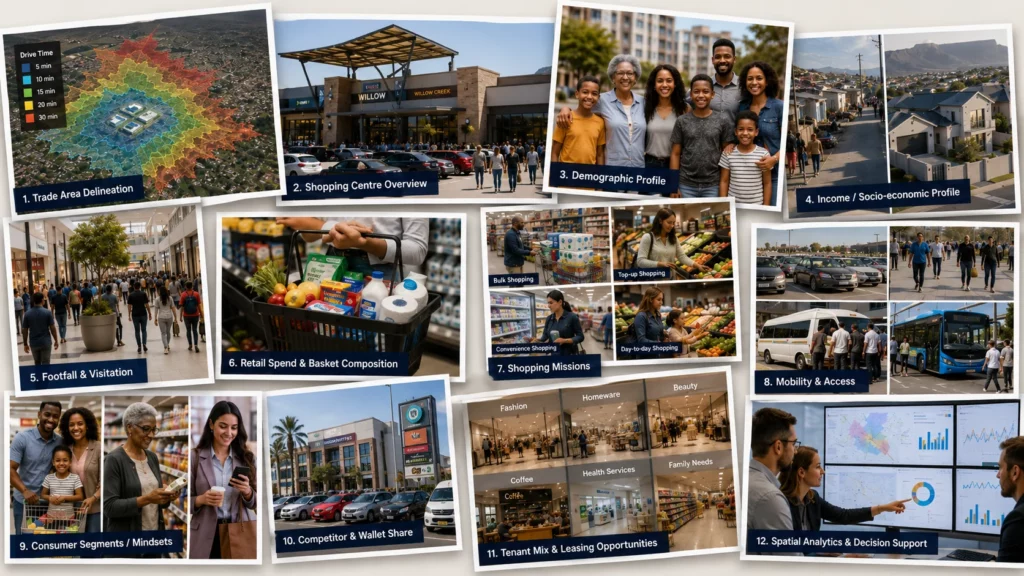
A shopping centre profile should do more than describe an asset.
It should explain who the centre serves, where shoppers come from, what they buy, where spend leaks, and which leasing decisions can increase performance.
For property owners, this is where geospatial intelligence becomes vital. A strong profile links the shopping centre to the surrounding trade area, consumer behaviour, competitor landscape, tenant mix, mobility patterns and spend potential.
GeoScope’s approach combines demographic modelling, Marketing All Products Survey (MAPS) consumer data, GIS analysis, trade-area delineation, shopper-origin mapping and category-level spend analysis to turn a shopping centre profile into an investment and leasing tool.
Key Takeaways
- A shopping centre profile should start with a defensible trade area.
- The strongest profiles combine demographics, LSM/SEM, consumer mindsets, spend, mobility, visitation and competitor behaviour.
- Tenant strategy should focus on market characteristics, shopping behaviour, category gaps, spend leakage and shopper missions.
- Consumer segmentation helps owners understand why different households use the centre differently.
- GeoScope can help property owners move from descriptive reporting to evidence-led leasing, marketing and property strategy.
Start with the Defining the Trade Area
The first question should be simple – which households and consumers do the shopping centre realistically serve?
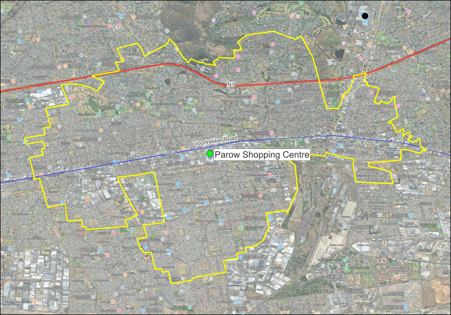
A best-practice profile should not rely only on a circular buffer or drive-time analysis. A 5 km radius or 12 minute drive time may look amazing on a map, but shoppers do not move in straight lines or simply considering travel time. They follow roads, public transport routes, taxi corridors or railway lines to make school or work trips considering competing retail destinations as they go.
A better method uses network-based accessibility. This means the trade area is built from the shortest travel time across the road network, adding the most accessible geographic areas until the centre reaches a logical market threshold. GeoScope uses this kind of approach, where the trade area is delineated through shortest travel time in reaching a target market or population threshold.
Profile the Shopping Centre in Commercial Terms
Once the trade area has been defined, the profile should describe the shopping centre in commercial language.
This should include the centre classification, gross leasable area, anchor tenants, parking supply, average monthly footfall, access routes, trade-area population and positioning. These measures help owners understand whether the centre behaves like a convenience centre, community centre, regional centre or destination retail node.
The point is not only to list the facts. The profile should explain what the facts mean. For example, a regional centre with strong grocery anchors, commuter access and high repeat usage may not need to compete as a fashion-led destination. It may perform better by strengthening its role as an everyday, value-led and service-rich centre.
Understand the Target Market Behind the Spend
A shopping centre profile must answer – who lives in the trade area?
This includes total population, household numbers, age structure, gender, race, household size, income, life stage and socio-economic status. These indicators provide the first layer of demand. They show whether the centre serves young families, working adults, students, pensioners, commuters, higher-income households, lower-income value shoppers or mixed urban communities.
GeoScope adds value by mapping this information at a granular level. Instead of reporting only municipal averages, the analysis shows how demand changes from one suburb or community to another. This matters because shopping centres often sit between very different residential markets.
Segmentation Comprehensively Defines Consumer Capacity
Demographics tell us who people are. LSM, SEM and consumer capacity indicators show how they live, what they can access, and how much spending potential they may have.
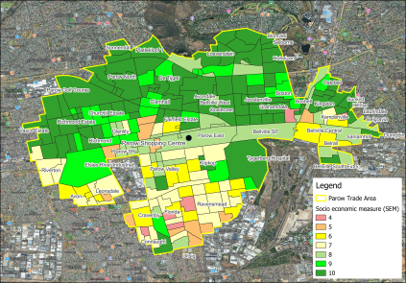
A strong profile should map living-standard patterns and socio-economic measures across the trade area. This helps owners distinguish between areas with higher purchasing power, middle-market stability, emerging potential and essential-spend dependence.
The uploaded shopping-centre profile uses LSM and SEM patterns to identify stronger upper-market pockets, broad middle bands and lower-middle areas within the same trade area. This type of analysis is valuable because it prevents a centre from being positioned too broadly or too narrowly.
Measure Visitation and Shopping Missions
A property owner needs to know whether the centre is used for weekly grocery trips, top-up shopping, day-to-day convenience, bulk purchases, commuter stops, services, food, entertainment or comparison shopping.
MAPS data can help quantify these missions. It can show past-week and past-month visitation, number of visits, category spend, grocery behaviour, in-store versus online shopping, transport mode and reasons for travel.
MAPS is particularly useful because it provides a nationally representative, geo-codable view of South African consumer behaviour, products, brands, media and purchase patterns. The Marketing Research Foundation (MRF) describes MAPS as a modern replacement for AMPS, with product, brand, media, behavioural and decision-making measures that can be geo-coded for regional analysis.
Analyse Consumer Spend across Category
Footfall alone does not tell the full story. A centre may attract many visitors but still lose spend in specific categories.
A best-practice profile should compare category spend across groceries, toiletries, health and beauty, cosmetics, apparel, electronics, restaurants, fast food, medical products, household goods, communications and services. It should also separate total spend from spend intensity. This distinction matters because a centre may have high category penetration but low average basket size.
Grocery-led spend, restaurants/QSR, health and beauty, cosmetics, apparel and competitor mall spend are analysed to identify where the centre is strong and where it loses higher-value shopping occasions.
Map Competitors and Potential Spend Leakage
No shopping centre operates in isolation. In many instances there is overlap between shopping centres of a similar type that may result in market cannibalization.
A profile should identify nearby shopping destinations by classification, size, role and likely draw. It should ask whether competing centres capture destination categories such as fashion, electronics, restaurants, entertainment or premium grocery spend.
This is where “leakage” becomes useful. Leakage does not mean the centre is failing. It means certain shopper occasions are being captured elsewhere. The strategic question becomes – which of those occasions should the centre try to win back?
The International Council for Shopping Centers or ICSC highlights the value of customer and trade-area data for site selection, tenant mix and marketing, noting that granular data helps owners understand where customers live, work, shop and spend. It also warns that owners should “meet the market” rather than overshoot it with a tenant mix that does not match the core shopper base. Read more about the use of data as an approach in location, tenant mix and marketing strategies.
Develop a Profile Specific Tenant Strategy
A shopping centre profile becomes valuable when it guides leasing.
The tenant strategy should not start with a generic wish list of brands. It should start with evidence – shopper missions, category gaps, spend leakage, competitor strengths, local income, consumer mindset, existing anchors and movement patterns.
For example, a grocery-led centre with strong commuter and family demand may have opportunities in value footwear, household basics, health services, coffee, quick-service food, beauty services, school needs, books, children’s products and practical homeware. A higher-income destination mall may need a different mix, such as premium fashion, lifestyle dining, jewellery, technology and entertainment.
ICSC’s work on tenant mix stresses that the right mix should match the community and that tenant placement matters, including visibility, adjacencies, shopper flow and category clustering.

Understanding the Consumer Mindset
Consumer mindset analysis adds the “why” behind the numbers.
GeoScope has created a consumer mindsets by combining psychographic, demographic and behavioural variables from MAPS with socio-economic indicators such as LSM, SEM, life stage, age, income, consumption capacity, consumption potential, connectivity, education, household structure and shopping behaviour.
Clustering can then group households into meaningful segments, such as value-driven practical shoppers, stable middle-market optimists, or younger connected achievers.
These segments show how different consumers think, what they prioritise, what brands may appeal to them, and whether they respond more strongly to price, convenience, family needs, digital connectivity, lifestyle, aspiration or essential spend.
Consumer Mobility is Key to Retail Performance
Mobility tells us how easily people can reach the centre and whether the centre fits into their daily routines.
A strong profile should include usual transport mode, weekday and weekend travel destinations, travel time, car ownership, walking behaviour, public transport use and commuter flows. These indicators explain whether the centre depends on local walk-in traffic, car-based convenience, taxi commuters, rail users, workers, students or weekend family trips.
This is especially important in South African cities, where shopping behaviour often reflects transport access as much as income. A centre located near taxi routes, rail stations, schools, workplaces and dense residential areas can play a powerful everyday role even if it is not the most premium retail destination in the region.
Build the Profile Around Strategic Questions
A useful shopping-centre profile should answer management questions, not only present data. In this regard the use of large language models and AI agents is a vital part decision making by property owners relating to shopping centre developments and investments.
It should help owners decide which categories to defend, which tenants to attract, which shopper segments to target, which marketing messages to use, which competitors matter most, and which parts of the trade area deserve more attention.
The profile should also separate core performance from upside. A centre may already dominate groceries and essential services. The upside may lie in increasing basket size, improving cross-shopping, extending dwell time, adding services, targeting weekday commuters, or reducing category leakage to nearby malls.
How GeoScope Can Help Property Owners
GeoScope can help shopping centre owners create a full evidence-led asset profile that combines spatial, demographic, behavioural and retail analytics.
A complete shopping-centre profiling assignment can cover:
- Trade-area delineation using road-network accessibility and market thresholds.
- Demographic and household profiling, including age, gender, race, household size and growth trends.
- Income, LSM, SEM and consumer-capacity mapping.
- MAPS-based retail spends, visitation, shopping behaviour and category analysis.
- Consumer mindset and psychographic segmentation.
- Competitor mapping and wallet-share analysis.
- Customer-origin, hub-and-spoke and Circle Point Analysis.
- Mobility, transport and weekday/weekend movement analysis.
- Tenant-gap analysis and brand-led leasing opportunities.
- Strategic recommendations for positioning, marketing, leasing and asset planning.
Contact GeoScope about a shopping-centre profile.
The Real Value – Better Strategic, Marketing and Leasing Decisions
A shopping centre profile should help owners move from intuition to evidence.
It should show whether the centre is correctly positioned, whether the tenant mix matches local demand, whether the trade area has enough spending power, whether shoppers are leaking to competitors, and whether new brands can realistically improve performance.
This approach also helps owners avoid expensive mistakes. It reduces the risk of chasing brands that do not fit the market. It identifies under-served categories. It supports leasing conversations with evidence. It helps marketing teams target real shopper segments. It gives asset managers a clearer view of where growth can come from.
FAQ
1. Why is trade-area analysis more useful than a simple radius or drive time?
A simple radius or drive time assumes that shoppers travel equally in every direction, but real shoppers follow roads, use taxis, travel by bus or rail for work or school trips, that consider competitor shopping centres and natural barriers to their movement. A network-based trade area considers these factors and more to give a more realistic view. This helps owners understand which households can realistically be a centre market and which consumers are more likely to shop elsewhere. It also improves demographic, income and spend estimates because the analysis uses the market that the centre can actually serve.
2. What data should a shopping-centre profile include?
A strong profile should include a shopping centre overview, trade area, population, households, income, LSM, SEM, consumer segments, visitation, spend by category, mobility, transport, competitor centres, customer origins, tenant mix and spend leakage. It should also include strategic interpretation. The goal is not to produce a data dump. The goal is to show what the numbers mean for positioning, leasing, marketing and investment. The best profiles connect the surrounding market to practical decisions such as tenant targeting, category expansion, promotional activity and customer retention.
3. How does consumer mindset analysis help property owners?
Consumer mindset analysis helps owners understand the motivations behind shopping behaviour. Two households may have similar income levels but very different priorities. One may focus on value, essentials and reliability. Another may respond to aspiration, brands, convenience and lifestyle. By combining MAPS variables, demographics, socio-economic indicators, life stage, shopping behaviour and psychographics, GeoScope can identify consumer groups that explain how different parts of the trade area think and spend. This helps property owners shape tenant mix, marketing messages, events, services and brand targeting around real consumer needs.
4. How can a shopping-centre profile support leasing?
A profile supports leasing by showing which categories have demand, which categories leak to competitors, and which brands fit the local market. It gives leasing teams evidence for approaching tenants and helps owners prioritise categories that can increase basket size, dwell time and repeat visits. For example, if the centre already performs strongly in groceries but loses spend in footwear, beauty services or household goods, the leasing strategy can focus on practical brands that complement existing footfall. This turns leasing from a vacancy-filling exercise into a targeted growth strategy.
