


Navigating the Retail Landscape: Pick n Pay’s Turnaround Requires a Strategic View of the Market
Pick n Pay faces significant hurdles, including fierce competition from local grocery retailers and economic pressures impacting consumer spending. Load-shedding costs and recent restructuring expenses have strained Pick n Pay’s financials, leading to a reported 97.5% drop in trading profit according to the Daily Investor while the Daily Maverick reports an expected 20% decrease in annual earnings per share from the previous year. Many stakeholders remain cautiously optimistic that Summers’ leadership and a streamlined business approach could indeed turn Pick n Pay’s fortunes around, though the journey is likely to be long and require overcoming substantial market, financial, and operational pressures.
To accomplish this, a thorough understanding of the principles encompassed within the “diamond of retail network optimization” is required – a concept developed by GeoScope South Africa. These principles include understanding the economic principles of supply and demand – where are my stores located and those of my competitors in relation to my target market. To understand one’s target market a few sources of information exist in South Africa. One is the data from the Marketing All Product Survey (MAPS) of the Market Research Foundation (MRF).

One must go further than understanding supply-demand aspects and consider all the intricacies of consumer purchasing behaviour within the target market. Aspects that need to be considered include the market’s lifestyles, product preferences and spending frequencies. This must all be done at a granular level, which is where GeoMAPS plays a critical role. It provides consumer behaviour data of a grocery brand like Pick n Pay at a community level so that more targeted strategies can be implemented. These strategies can include identifying locations for new stores of a particular type and closing stores that are not performing and not optimally located within the brand’s target market.
This talks to the final component of the “diamond of retail network optimization” – access. Access is about optimizing a brand’s retail store network within its target market, considering consumer’s modes of transport. Accessibility modelling is the term used to describe the method where all these factors are considered in optimizing a brand’s retail network. This includes identifying the size of the target market required for different store types and sizes to be financially viable and the average travel time consumers are willing to travel to reach these stores. When looking at the store location one has to consider detractors that draw market share away from a brand (eg direct competitors) and attractors that lure customers to a brand’s stores (eg shopping malls).
Positioning for Profit: Pick n Pay’s Market Focus and Retail Network Key to its Turnaround
An analysis of Pick n Pays in-store shopping shows that it presently sits within a distinct part of the market compared to other grocery brands. It is located in the upper rural and lower urban township lifestyle segments with the predominant monthly household income ranges of R700 – R2 000 and R11 000 – R16 000. This is in contrast to Checkers which is distinctly focused on the higher lifestyle segments earning monthly household incomes ranging from R5 000 – R25 000. This is the same market where Makro and Woolworths are strongly positioned. Pick n Pay’s Boxer brand also sits in a distinct market focusing primarily on rural communities and towns earning in the range of R1 000 – R2500 and R80 000-R90 000, which shows the dichotomous nature of this market.
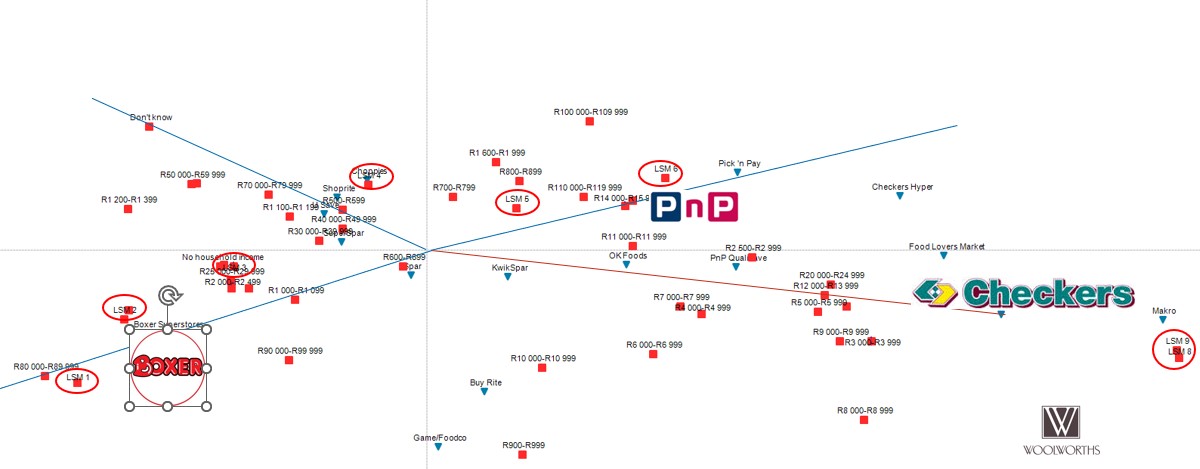
Nevertheless, Pick n Pay’s Boxer brand is performing above expectations, showing growth potential that the company will need to leverage to strengthen its balance sheet. Pick n Pay’s potential for a successful turnaround hinges on both strategic changes and external challenges. Recently appointed CEO Sean Summers, who led the company through a growth phase in the past, is focusing on revitalizing core operations and closure of some underperforming supermarkets. Summer aims to enhance customer service and streamline supermarket operations, an approach supported by the management team and seen as crucial by analysts to regain stability and profitability.
The use of geospatial consumer data to reposition the brand in more profitable and mainstream markets must be a key focus of their strategic approach. Understanding these markets and what the turnover of different store types requires for them to be financially viable is vital in establishing a strong retail network for Pick n Pay. While the next three years at least will be challenging, analysts and the company remain hopeful that Pick n Pay’s new strategic focus will begin to show results in the medium term, particularly if the economic environment improves.
For more information on GeoMAPS consumer data click here
Click here for more information on retail network optimization.
